01What you need
- Two pieces of soft rope or cord about an arm's length each, two colors if you have themHave / $5
- A chair leg or a broom handle to tie aroundHave
- A small bundle to tie up: sticks, pencils or a rolled towelHave
Where: A kitchen table, a porch, or a picnic table.
Rope safety: read this first
- Nothing around necks, ever, not even as a joke. Rope stays on chair legs, broomsticks and bundles.
- These are practice knots. Nothing in this plan holds a person, climbs, or lifts anything heavy.
- Don't join two ropes with a square knot to hold weight. It's a binding knot for bundles and bandages, and it can slip loose under load.
02Steps
Warm up with an overhand knot
KidMake a loop in one rope and pass the end through it. That's the overhand knot, the one most people tie without thinking. Tie three in a row along the rope.
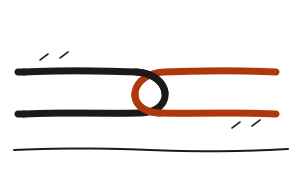
Square knot: right over left
Dad showsKid copiesHold one end in each hand. Cross the right end over the left and tuck it under, like the first step of tying a shoe.
Then left over right
Dad showsKid copiesNow cross the left end over the right and tuck it under, and pull both ends. A square knot lies flat, and each end comes out beside its own loop. If it twists and looks crooked, it's a granny knot: untie it and do the second half the other way.
Use it for what it's for
KidTie the square knot around the bundle of sticks or the rolled towel. This is its job: tying up a bundle or a bandage. Then push the two loops toward each other and watch it spill open. That's why it's not for holding weight.
Bowline: the rabbit and the tree
Dad showsMake a small loop in the rope (the rabbit hole), with the long part (the tree) above it. The rabbit comes up out of the hole, goes around behind the tree, and goes back down the hole. Pull it snug. You get a loop that won't slip smaller and still unties easily later. Try it around a chair leg.
Race and blindfold round
KidEach knot five times, fastest wins. Then try the square knot with eyes closed. When they can tie it without help, sign their field card.
03Variations
Ages 3–5
Just the overhand knot, tied around a broom handle. Then untying knots Dad tied, which is harder than it sounds.
Ages 6–9
Overhand and square knot. Save the bowline for when the square knot is easy.
Ages 10+
All three, then the bowline around their own waist over a jacket, tied without looking, as sailors learn it. Practice only: nothing hangs from it.
RainThis is the rainy-day plan. Kitchen table.
ColdSame as rain: indoors, or a porch with gloves off just to tie.
HotShade and a picnic table. Wet rope is harder to tie, which makes a good challenge.
The Friday letter
Get one weekend plan every Friday
A field card like this one for the weekend, one quick plan for a weeknight, and nothing else. Free. The first letter hasn't gone out yet. Sign up now and you'll get it.
One weekend plan every Friday. We never sell your address, and every letter has a one-click unsubscribe. See a sample issue · Privacy
04Sources
- The knots. Clifford W. Ashley, The Ashley Book of Knots (1944): the reef or square knot (#1204), which Ashley classes as a binding knot and warns against using to join two ropes, and the bowline (#1010).
Filed under: Indoor & Rainy Day