The 1911 book calls it a hunter's clock: a board, a slanted pointer aimed north, and a shadow that tells the time. Build it in the morning, mark an hour line each time the clock strikes, and by evening you have a clock that runs on the sun.
Dad Field Manual editors · Drafted with AI help · Published Oct 15, 2026
A flat board or stiff cardboard about 15 inches squareHave
A piece of stiff cardboard for the pointerHave
A protractor, ruler, marker, scissors and tape or glueHave
A phone with a compass app and a map that shows your latitudeHave
A clock or phone to mark the hoursHave
A couple of rocks or bricks to hold the board downFree
Where: A deck rail, a stump, a flat patio stone or a level patch of yard that gets sun all day and where the dial can stay put.
Before you start
Never look at the sun, not even with sunglasses. Look at the shadow on the board, never the sky.
Grown-ups handle the scissors or saw for the pointer.
Hats and sunscreen if you'll be out checking the dial all day.
02Steps
Find your latitude and north
DadLook up your latitude on a phone map: a number of degrees north, like 36. Then find north with the phone compass, or the night before sight the North Star the way the 1911 book does (see find the North Star). Mark north on the deck or ground with tape or a stick.
Cut the pointer
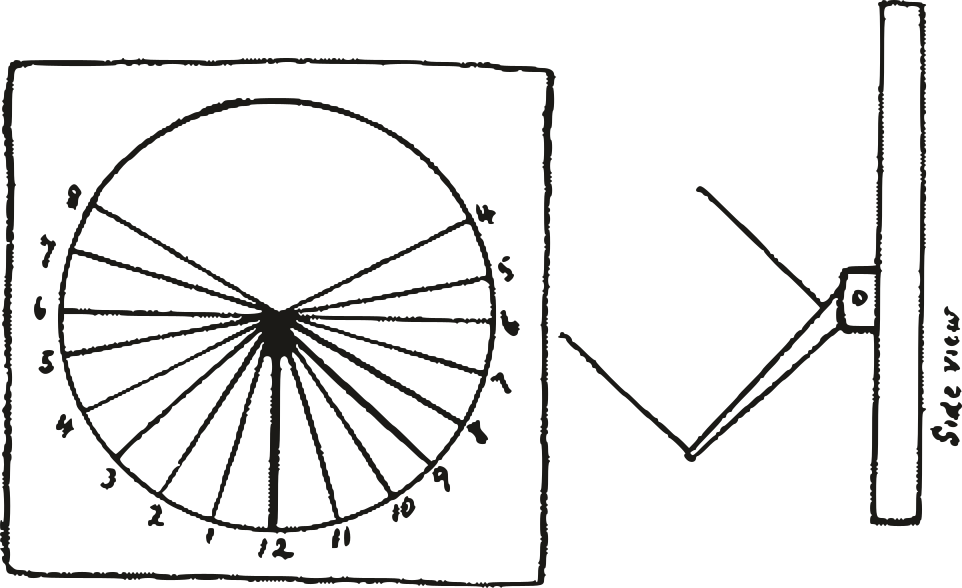
Dad showsKid copiesThe pointer is called a gnomon. Cut a cardboard triangle with a square corner, and use the protractor to make the angle at its tip equal to your latitude. The long sloped edge is what casts the shadow.
FIG: Sundial, or hunter's clock, from the 1911 scouting handbook, p. 58.
Build and aim the dial
KidDraw a line down the middle of the board: that's the noon line. Tape or glue the pointer upright along it, tip at the south end, so the sloped edge rises toward the north. Set the board level, noon line pointing north, and weigh it down. From now on, don't move it.
Mark the hours by the clock
KidEvery hour, on the hour, draw a line along the edge of the shadow and write the hour. While daylight saving time is on (in most of the US, until the first Sunday in November), write one hour less than the clock says: at 2:00 on the clock, write 1. Then the dial keeps standard time all year.
Read it the next day
TogetherNext sunny day, ask, “What time does the sundial say?” Then check the clock. In daylight saving time, add an hour to the dial's answer. How close did it get?
Check it again in a month
TogetherLeave it out, or put it back in the same spot aimed the same way. In a month, check it against the clock again. A few minutes off is normal: sun time drifts against clock time through the year.
03If it stalls
If clouds roll in partway through, mark what you can and finish the hours on the next sunny day. Don't move the board.
If the shadow is fuzzy, read the middle of the fuzzy edge, and trace with a ruler.
If the dial reads an hour off, check whether daylight saving time is on.
04Variations
Ages 6–7
Skip the latitude angle: stand a pencil straight up in a lump of clay on a paper plate, and mark the hours by the clock. It works best the same week you mark it.
Ages 8–11
The full plan. Try the [shadow-stick](/plans/shadow-stick/) to find north, then compare it with the phone compass.
Ages 12+
Use the hour-line angles on NASA's sundial page to draw the lines with a protractor before the sun does it, then see how well they match. Compare with the [watch compass](/plans/watch-compass/), which runs the same idea backward.
CloudyYou need a clear shadow. Wait for a sunny day.
WindyWeigh the board down well, or tape it to the deck.
A field card like this one for the weekend, one quick plan for a weeknight, and nothing else. Free. The first letter hasn't gone out yet. Sign up now and you'll get it. beehiiv, which sends the letter, will email you once to confirm your address.
One weekend plan every Friday. We never sell your address, and every letter has a one-click unsubscribe. See a sample issue · Privacy
1911 scouting handbook, pp. 58–59. The 1911 book describes a scout's sundial, or hunter's clock: a smooth board about 15 inches across, set on a level post or stump in the open, with its twelve o'clock line aimed north by the North Star and a pointer set to aim at the North Star, at the same angle as the latitude. It says the dial is roughly correct for that latitude and the pointer angle must change for each latitude. Project Gutenberg (public domain in the USA) Checked Oct 15, 2026
Pointer angle, hour lines and sun time vs. clock time. NASA's archived sundial page says a sundial works at all times of year if its pointer slants toward the celestial pole, at an angle to the base equal to your latitude, and must point north; it lists unequal hour-line angles for a flat dial; and it says the dial is an hour off during daylight saving time, differs from clock time because of time zones, and has a yearly variation (the equation of time) of up to about 15 minutes. NASA Goddard Space Flight Center (archived) Checked Oct 15, 2026
Never look at the sun. NASA says it is not safe to look directly at the Sun without specialized solar eye protection, and that regular sunglasses, however dark, are not safe for viewing the Sun. NASA Science Checked Oct 15, 2026
Daylight saving time dates. NASA gives the US rule: daylight saving time begins at 2 a.m. on the second Sunday of March and ends at 2 a.m. on the first Sunday of November. NASA Goddard Space Flight Center Checked Oct 15, 2026
Dad Field Manual · Field card 121 · Classic Field Skills
Make a sundial and mark the hours
The 1911 book calls it a hunter's clock: a board, a slanted pointer aimed north, and a shadow that tells the time. Build it in the morning, mark an hour line each time the clock strikes, and by evening you have a clock that runs on the sun.
Time
1 hr, spread over a sunny day
Cost
$0
Ages
6 and up
Where
A sunny, level spot
Since 1911: The 1911 book lines the dial up with the North Star at night and divides it into 24 equal parts. On a flat board the hour lines aren't evenly spaced (NASA's sundial page lists the angles), so this plan marks them by the clock instead. A phone compass can find north. Sundials keep sun time: during daylight saving time they read an hour behind the clock, and sun time drifts against the clock through the year by up to about 15 minutes. Never look at the sun to aim it.
What you need
A flat board or stiff cardboard about 15 inches square
A piece of stiff cardboard for the pointer
A protractor, ruler, marker, scissors and tape or glue
A phone with a compass app and a map that shows your latitude
A clock or phone to mark the hours
A couple of rocks or bricks to hold the board down
Before you start
Never look at the sun, not even with sunglasses. Look at the shadow on the board, never the sky.
Grown-ups handle the scissors or saw for the pointer.
Hats and sunscreen if you'll be out checking the dial all day.
Steps
Find your latitude and north. Look up your latitude on a phone map, find north, and mark it on the ground.
Cut the pointer. Cut a right-triangle pointer with its tip angle equal to your latitude.
Build and aim the dial. Glue the pointer on the noon line, sloped edge rising north. Set it level, aimed north, and weigh it down.
Mark the hours by the clock. Each hour on the hour, trace the shadow and label it. During daylight saving time, label it one hour less.
Read it the next day. Read the dial, then check the clock. Add an hour during daylight saving time.
Check it again in a month. In a month, check it against the clock again. A few minutes off is normal.
If it stalls
If clouds roll in partway through, mark what you can and finish the hours on the next sunny day. Don't move the board.
If the shadow is fuzzy, read the middle of the fuzzy edge, and trace with a ruler.