Forty-five minutes, a knotted rope, a few sticks and a sheet of paper. Find how wide a creek is from your own side, then try it across the yard where you can check the answer with a tape.
Dad Field Manual editors · Drafted with AI help · Published Oct 15, 2026
A rope or string about 13 feet long, with knots at 0, 3, 7 and 12 feetHave / $5
4 to 6 sticks or tent pegs for markersFree
A square sheet of paper and a book or clipboard to hold it flatHave
A tape measure, or count heel-to-toe stepsHave
A child's life jacket, for the creek versionHave / $30
Where: Flat, dry ground with a tree or post on the far side: a yard, an empty field, or a level path well back from a creek.
Water safety: read this first
An adult watches the kids closely the whole time near water. No phone, no wandering off.
Stay well back from the edge. Every peg goes on dry, flat ground on your side. Nobody wades in to check.
Life jackets near natural water. The CDC says children should wear them in and around creeks, rivers and lakes.
Any child under 5 who comes along stays within arm's length of an adult, as the AAP advises.
02Steps
Make a square corner with the rope
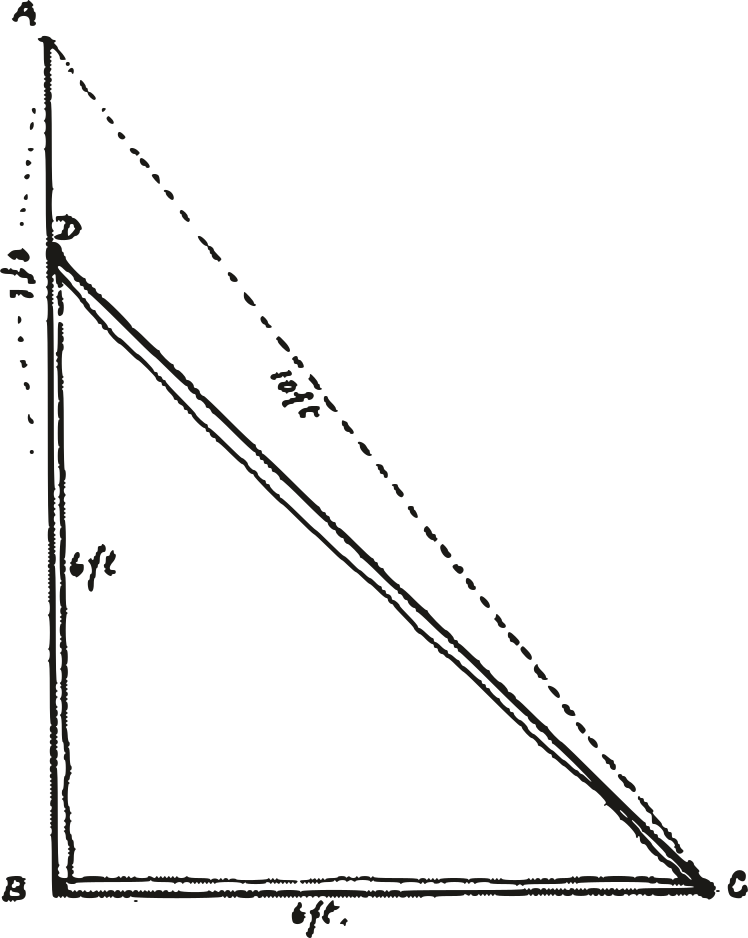
Dad showsKid copiesPeg the rope's first and last knots together. Pull it into a triangle with sides of 3, 4 and 5 feet and peg the corners. The corner between the 3 and 4 sides is a true square corner. The 1911 book uses 6, 8 and 10: the same shape, twice as big.
FIG: A right angle from a 6-8-10 triangle, from the 1911 scouting handbook, p. 64.
Pick a landmark across
TogetherChoose a tree, post or big rock right on the far side and call it X. On dry ground well back from your edge, put peg B straight across from it. Set the rope's square corner at B, with the 4-foot side pointing at X. The 3-foot side now runs along your bank.
Fold a sighting triangle
KidFold the square sheet corner to corner. That gives a triangle with two equal short sides, like the 1911 book's six-by-six triangle. Its two pointed corners are half a square corner each.
Walk along until X lines up
KidWalk from B along the line of the 3-foot side, staying the same distance from the water. Stop now and then, hold the triangle flat on the book with a pointed corner toward you, point the short edge back at peg B and look along the fold. When the fold points straight at X, put in peg C.
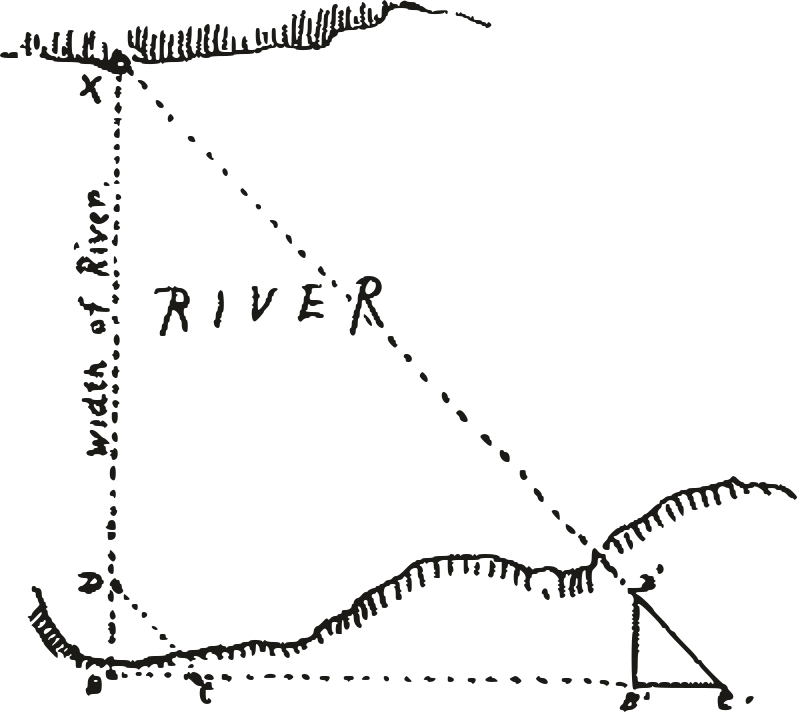
FIG: Measuring a river's width from one bank, from the 1911 scouting handbook, p. 65.
Measure B to C
TogetherMeasure from peg B to peg C with the tape or by steps. That is the distance from B straight across to X. Take off the distance from B to your edge, and roughly how far X sits back from the far edge, and you have the water's width.
Check it on the yard
TogetherRepeat with a tree across the yard as X. This time walk a tape straight from B to the tree and compare. Ask: "How close did the triangle get?"
03If it stalls
If the answer is far off, peg B probably wasn't straight across from X. Re-sight along the rope's 4-foot side.
If the paper flops, tape it to the book cover.
No creek nearby? Lay two ropes on the lawn as a pretend river and use a tree beyond them.
04Variations
Ages 6–7
Do the yard version only. Kids lay the rope and pegs; Dad does the sighting and the subtraction.
Ages 8–11
The full plan, starting on the yard and moving to a creek once it works.
Ages 12+
Try the 1911 method on p. 66 for the distance between two trees on the far side, using two square-cornered triangles.
After rainCreeks run higher and banks get slick. Do the yard version and save the creek for a dry day.
ColdStay off ice on any creek or pond. The yard version works in any season.
A field card like this one for the weekend, one quick plan for a weeknight, and nothing else. Free. The first letter hasn't gone out yet. Sign up now and you'll get it. beehiiv, which sends the letter, will email you once to confirm your address.
One weekend plan every Friday. We never sell your address, and every letter has a one-click unsubscribe. See a sample issue · Privacy
1911 scouting handbook, pp. 64–66. The 1911 book says a triangle with sides of six, eight and ten feet or inches makes a true right angle opposite the ten. It describes measuring across a river without crossing by setting a right-angled triangle with two equal sides on the bank in line with a mark across, moving it along the bank until its long side lines up with the mark, and measuring the base. It also shows how to measure between two distant objects with right triangles. Project Gutenberg (public domain in the USA) Checked Oct 15, 2026
Supervision and life jackets near water. The CDC says to designate a responsible adult to supervise closely and constantly when children are in or near water, that children should use life jackets for all activities in and around natural water, and that lakes and rivers have hidden hazards such as currents, rocks and limited visibility. Centers for Disease Control and Prevention Checked Oct 15, 2026
Arm's-length supervision for young children. The American Academy of Pediatrics recommends staying within arm's length of young children with constant touch supervision around water, says children should wear life jackets in, on or near lakes and rivers, and lists drainage ditches as a water hazard. American Academy of Pediatrics (HealthyChildren.org) Checked Oct 15, 2026
Dad Field Manual · Field card 90 · Classic Field Skills
Measure across a creek without crossing it
Forty-five minutes, a knotted rope, a few sticks and a sheet of paper. Find how wide a creek is from your own side, then try it across the yard where you can check the answer with a tape.
Time
45 min
Cost
$0
Ages
8 and up
Where
Yard, field or creek bank
Since 1911: The 1911 book measured across rivers from the bank. Today the CDC says a responsible adult should supervise closely and constantly whenever children are near water, and that children should wear life jackets around natural water. Work from flat ground well back from the edge, or practice across a yard first. The book's 6-8-10 triangle works the same as a smaller 3-4-5.
What you need
A rope or string about 13 feet long, with knots at 0, 3, 7 and 12 feet
4 to 6 sticks or tent pegs for markers
A square sheet of paper and a book or clipboard to hold it flat
A tape measure, or count heel-to-toe steps
A child's life jacket, for the creek version
Water safety: read this first
An adult watches the kids closely the whole time near water. No phone, no wandering off.
Stay well back from the edge. Every peg goes on dry, flat ground on your side. Nobody wades in to check.
Life jackets near natural water. The CDC says children should wear them in and around creeks, rivers and lakes.
Any child under 5 who comes along stays within arm's length of an adult, as the AAP advises.
Steps
Make a square corner with the rope. Peg a knotted rope into a 3-4-5 triangle; the corner between the 3 and 4 sides is square.
Pick a landmark across. Pick a landmark X across; put peg B opposite it, with the rope's square corner there.
Fold a sighting triangle. Fold a square sheet corner to corner to make the sighting triangle.
Walk along until X lines up. Walk along the bank line; stop where the fold points at X while a short edge points back to B.
Measure B to C. Measure B to C. That equals B to X; subtract the dry ground on each side.
Check it on the yard. Repeat across a yard and check the answer with a tape.
If it stalls
If the answer is far off, peg B probably wasn't straight across from X. Re-sight along the rope's 4-foot side.